The Unexpected Has Been Expecting You
· by Lindsay Hiebert · lanternpost.app — free to send, free to receive
The phone is face-down on the nightstand. The alarm is set for later, a civilized hour, because the first flight of a vacation is supposed to begin in daylight. This one has been planned for months: Kansas City to Denver, Denver to Spokane, a rental car, and the last hour east to Coeur d’Alene. One connection. A lake by lunch.
He picks it up anyway. No reason. A glance.
One text, from Southwest. You’ve been rebooked. New flight, 6:20 a.m., Kansas City to Phoenix. A second flight at 8:00, Phoenix to Spokane. Your seats may also have changed. A confirmation code. A link.
The Denver connection is gone. The departure has moved almost two hours earlier. The morning that was planned down to the boarding group has been rewritten while he slept, and the only thing between him and a missed vacation is the fact that his hand reached for the phone before the phone had any business being reached for.
He is going to make it. That much can be said now. But he does not know it yet, and for the next hour neither will you.
The glance
Heraclitus, writing about twenty-five centuries before Southwest Airlines, left a fragment that sounds at first like the modern cliché and turns out to be its opposite: If you do not expect the unexpected, you will not find it, for it is trackless and unexplored.
The cliché says brace yourself. Surprise is an ambush; stand ready. Heraclitus says something stranger. The surprise may never arrive at all unless you are disposed to receive it. The unexpected is trackless by definition, so a mind that travels only on tracks is structurally incapable of meeting it. What looks like luck is usually an open door that happened to be open.
The glance at the phone was the open door. Nothing about it was planned. The habit behind it was.
The run
Bag. Keys. The Uber app, and the small theater that follows it: Finding your ride. Then nothing. Then the map, and a car icon that does not move, and the minutes that do. Connecting you with a driver. A name. A plate. Three minutes away, which on a morning like this is a number you say out loud.
The drive to MCI in the dark, the kind of dark that still belongs to the night before.
Security. The line is short because nobody sane is here yet. Shoes off. Shoes on.
Gate B69. The board already says BOARDING.
He is the last one at the podium. The agent’s name tag says Matthew. Matthew has the look of someone who has been awake longer than his passengers and is still choosing to be kind about it. He scans the pass and explains, unprompted, what the text did not.
The original itinerary had him landing in Denver at 8:55 and leaving for Spokane at 9:00. Five minutes. Somewhere overnight, the system looked at that number and did the arithmetic he had not. Out of everyone at this airport, he was the one passenger whose connection would have broken. It found him, one name on one itinerary, and rerouted him around the failure before he knew there was one. Phoenix instead of Denver. An hour on the ground. A stop in Oakland where everyone gets off and gets back on. Then Spokane, then the drive. Four places to reach one. The seat he had chosen, gone.
The door closes behind him. The plane moves.
Accidents and sagacity
Horace Walpole coined serendipity in 1754, borrowing from a Persian tale about three princes of Serendip who, he wrote, were always making discoveries, by accidents and sagacity, of things they were not in quest of.
The pairing is the point. Not accidents alone. Accidents and sagacity, the readiness to act on what the accident offers. The accident this morning was an airline’s algorithm noticing one fragile connection in a network of thousands. The sagacity was unglamorous: a hand on a phone, a fast drive, and a gate agent who decided that explaining was part of the job.
Seneca put it shorter. Luck is what happens when preparation meets opportunity. The preparation here was modest. It was enough.
The mouse
In November of 1785, Robert Burns was ploughing a field in Ayrshire when the blade turned up a mouse’s nest and destroyed it. He wrote the mouse an apology.
The best-laid schemes o’ mice an’ men / Gang aft agley, / An’ lea’e us nought but grief an’ pain, / For promis’d joy.
The best-laid plans of mice and men often go askew, and leave us nothing but grief and pain in place of the joy we were promised. It is the line everyone remembers. It is not where the poem ends.
Burns turns it on himself. The mouse, he says, is better off. It suffers only the present moment. The poet looks backward at what was lost and forward at what might be, and loses the present to both. The nest is wrecked either way. Only one of them is still living in the field.
This is the part the Japanese call wabi-sabi, though they arrived at it by a different road. Not the acceptance of failure. The recognition that the cracked, rerouted, imperfect version of the thing is still the thing, and is sometimes the truer version for having been broken and carried anyway.
The card that was already written
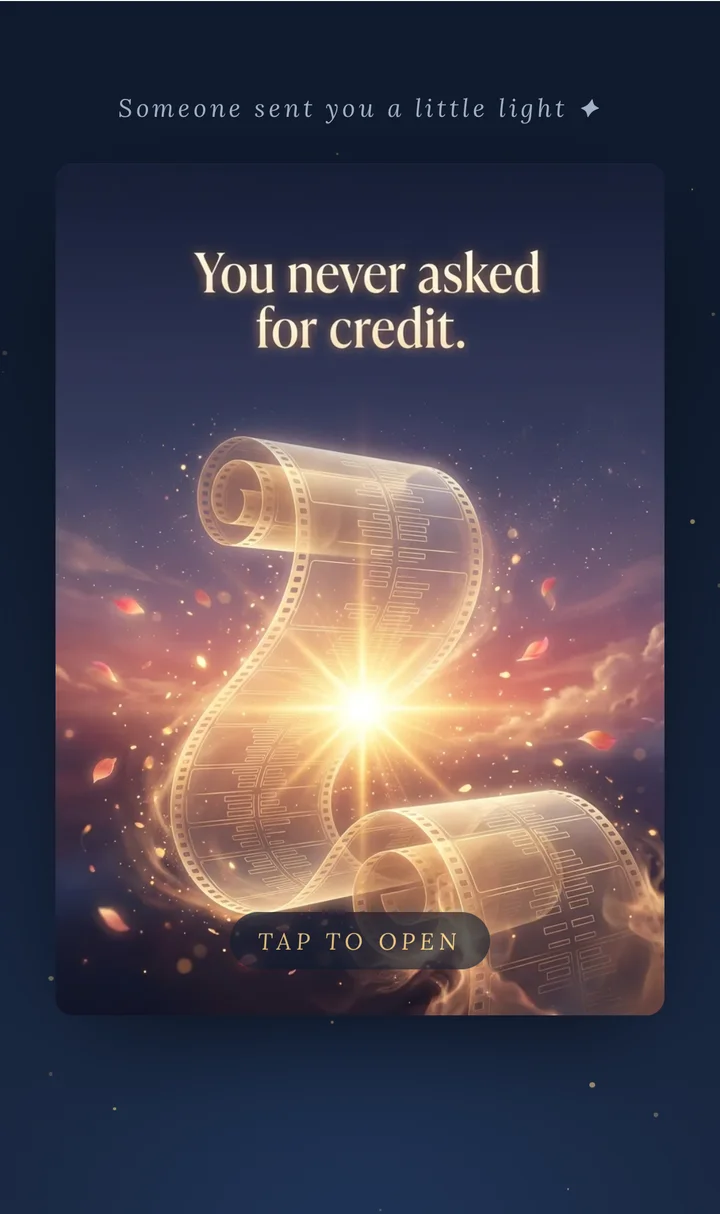
Lantern Post has a card for this morning. It was written weeks before the text arrived.
Someone moved the finish line. / You crossed it anyway.
The front sets it up. The inside lands it. Every card in the house is built that way, setup and reversal, and it is no accident that the shape matches the shape of a disrupted morning. The reveal is the oldest story form there is. Expectation, disruption, light. Burns built his poem on it. Heraclitus built a philosophy on it. An airline’s rebooking text, read at the wrong hour by the right hand, runs on the same machinery.
Lantern Post is a free digital greeting card with a secret inside: you light a card and hide a verified reveal — a song, a story, a verse — and the person you send it to taps a glowing lantern to open it. No account, no app, nothing to install.
Phoenix
The layover is an hour. The coffee is airport coffee. Terminal 4, gate D2, and then Oakland, and then Spokane, and then the lake in Idaho, which is still where it was. Months of planning produced one route. One night undid it and produced another. Both end at the same water.
Somewhere back in Kansas City a gate agent named Matthew is working the next flight, and the next, absorbing the friction that the algorithm could not. He will not remember this morning. It was, from his side of the podium, an ordinary one.
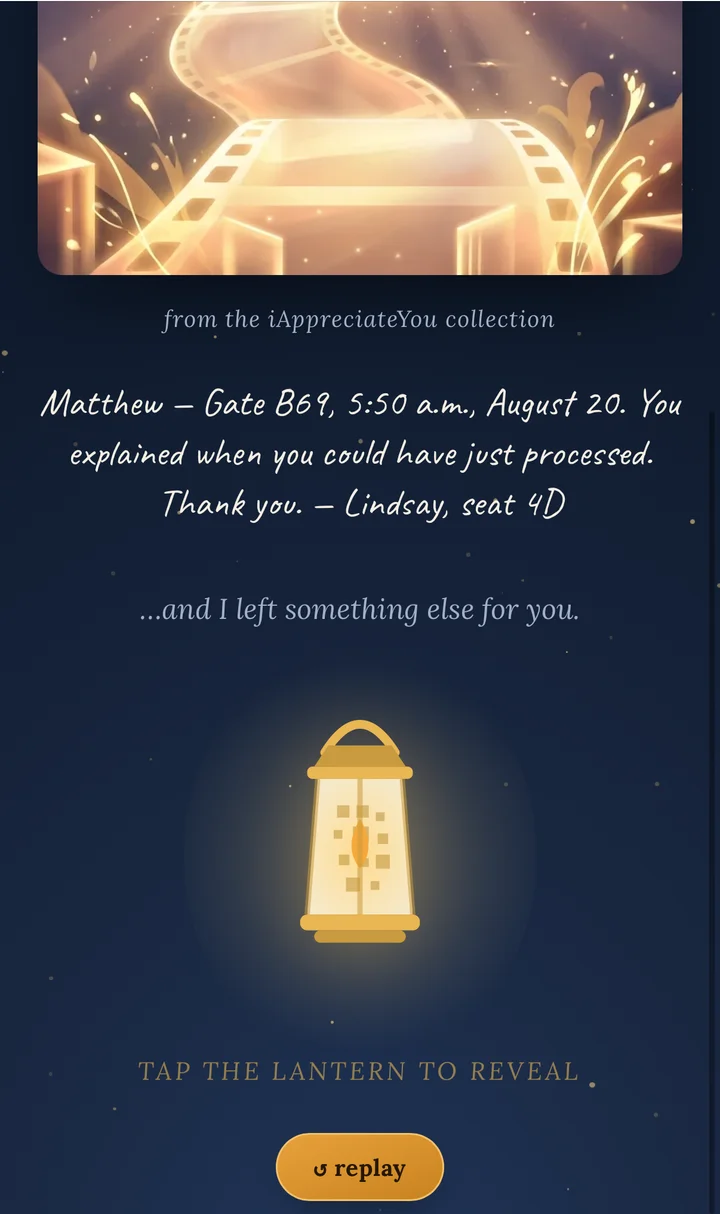
There is a lantern waiting for him. It says thank you on the front and something truer on the inside, and when he taps it, it will open.
The phone is face-up on the tray table now. The alarm, finally, goes off.
The card, made
This is the card. It is sealed for a gate agent named Matthew, and I don’t yet know how to get it to him. It will open for you exactly as it will for him — tap the lantern and the song arrives with the light.

Who moved your finish line this year? Who helped you cross it anyway?
Send a lantern — free, no account: lanternpost.app/create
Light is not meant to be stared at. It is meant to be carried — and to be handed on.